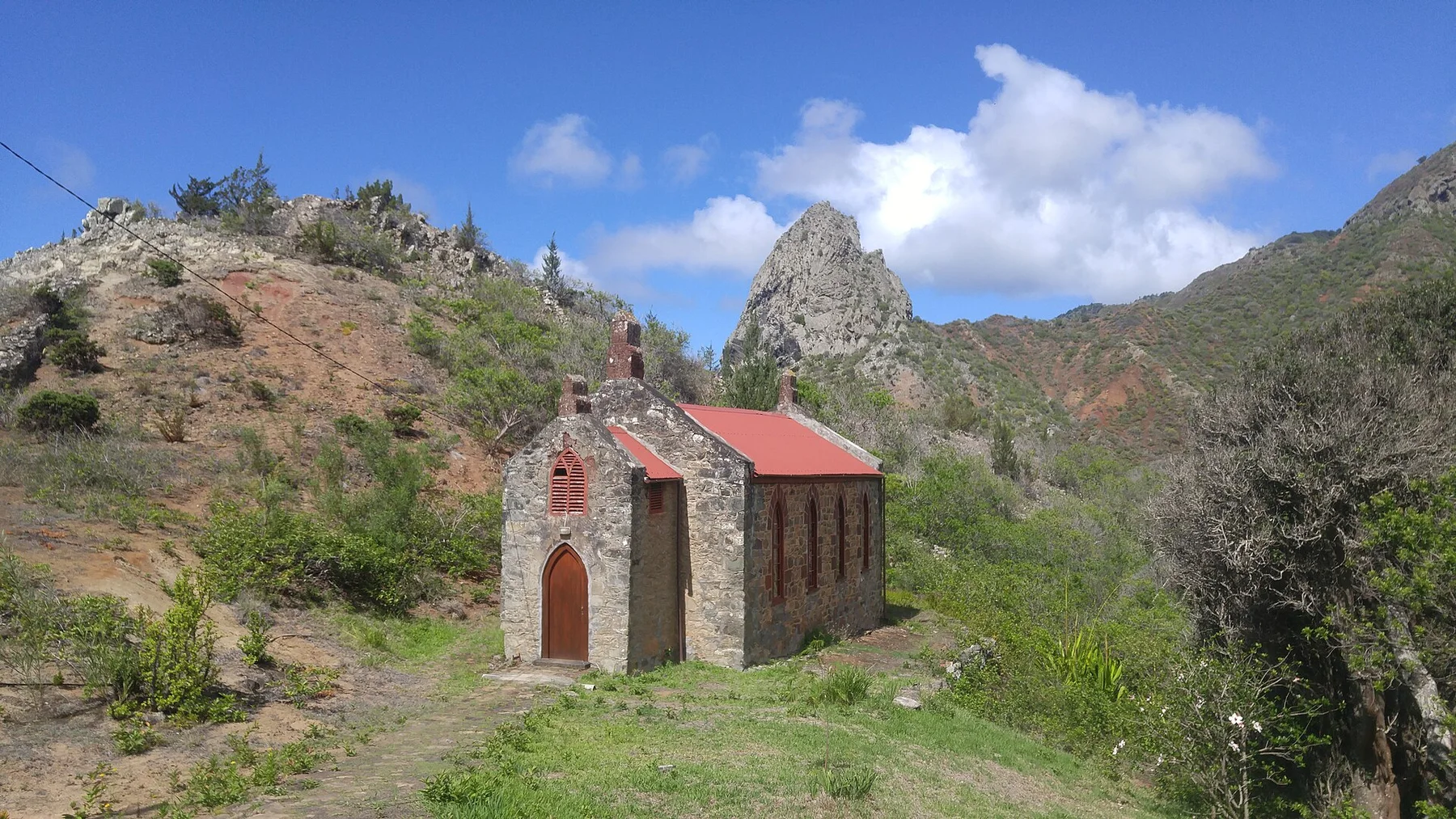
Climb toward Queen Mary's Peak above Edinburgh of the Seven Seas
The ascent reveals the entire inhabited landscape at once: village, potato patches, volcanic slopes and ocean with no neighbouring land in sight.
Plan the least frequent boat or flight first, then use the remaining time for the signature route rather than trying to collect every viewpoint.
Look a little closer
Worth discovering
The details that make Tristan da Cunha different.
Destination view
01
Queen Mary’s Peak
The volcano dominates the main island and holds a crater lake.
Destination view
02
Edinburgh of the Seven Seas
The settlement is one of the most isolated communities on Earth.
Destination view
03
The Patches
Communal potato fields reveal local adaptation to wind and terrain.
Photo journal
A closer look at Tristan da Cunha
14 photographs
01Ascension Sunset (112395107)02Tristan da Cunha — view 203Tristan da Cunha, British overseas territory-20March201204Storm approaching the settlement on Tristan da Cunha (Panorama)05Tristan departing 01 (3449570501)06Tristan arrival 08 (3449559787)07Maria S. Merian vor Tristan da Cunha08Tristan da Cunha09Tristan arrival 01 (3450374920)10Tristan da Cunha11Panorama of Tristan da Cunha, bright sunny day12The Main Settlement on Tristan da Cunha - Flickr - The Official CTBTO Photostream13Tristan Da Cunha (249833017)14Maria S. Merian vor Tristan da Cunha
Landscape and history
How time shaped Tristan da Cunha
The world's most remote inhabited archipelago rises from the South Atlantic around a single compact settlement. The deeper story links its visible features with the people and changes behind them.
4 min readSouth Atlantic, United Kingdom Overseas Territory
Tristan da Cunha is centred on South Atlantic, where the world's most remote inhabited archipelago rises from the South Atlantic around a single compact settlement. The strongest reason to make the journey is to climb toward queen mary's peak above edinburgh of the seven seas.
Many visits to Tristan da Cunha begin with the experience described as “Climb toward Queen Mary's Peak above Edinburgh of the Seven Seas”. The more revealing question is why it exists here, how people used the surrounding ground and what remains visible from earlier phases. The ascent reveals the entire inhabited landscape at once: village, potato patches, volcanic slopes and ocean with no neighbouring land in sight.
Because land is limited, every ridge, bay and passage acquires practical importance. At Tristan da Cunha, “Queen Mary’s Peak” is where that compressed geography becomes easiest to read. The volcano dominates the main island and holds a crater lake.
Tristan da Cunha is not a uniform area. Changes in elevation, exposure, water and substrate produce distinct environments over short distances, which is why a route through the place often reveals more than a fixed viewpoint.
02
Human history
The human landscape behind the scenery
Portuguese navigator Tristao da Cunha sighted the archipelago in 1506, but the cliffs, surf and distance prevented permanent occupation for another three centuries. A small community formed in the early nineteenth century, and Britain formally took possession in 1816, partly to prevent the island being used in attempts to free Napoleon from Saint Helena.
The settlement of Edinburgh of the Seven Seas grew on the only broad low terrace, where families combined fishing, livestock and communal potato plots known as The Patches. In 1961 a volcanic eruption opened beside the settlement and forced the entire population to evacuate to Britain; most islanders returned in 1963 after surveys showed that homes and farmland had largely survived.
03
Change
A landscape reorganised
The eruption remains the clearest modern turning point because it tested whether this isolated community would continue at all. The returned population rebuilt around a harbour, a small processing economy and tightly managed land, while the volcanic cone beside the village became a visible record of the crisis.
04
Visible evidence
The small features that reveal the larger pattern
At Tristan da Cunha, the feature “Queen Mary’s Peak” is best understood as part of the surrounding system rather than an isolated stop. The volcano dominates the main island and holds a crater lake. At Tristan da Cunha, the detail links local scale with the wider regional pattern.
At Tristan da Cunha, the feature “Edinburgh of the Seven Seas” is one of the most useful pieces of visible evidence. The settlement is one of the most isolated communities on Earth. Within Tristan da Cunha, the feature explains why this destination differs from nearby landscapes.
Look closely at the feature “The Patches” in Tristan da Cunha; it carries information that a panoramic view can miss. Communal potato fields reveal local adaptation to wind and terrain. At Tristan da Cunha, the detail links local scale with the wider regional pattern.
05
Living landscape
The place within its wider region
A single visit to Tristan da Cunha captures only one phase of its annual cycle. For Tristan da Cunha, the most reliable visiting window is Dec-Mar.
For Tristan da Cunha, the stated visiting window is Dec-Mar, but its practical meaning depends on local weather, water and transport rather than the calendar alone.
Placed within its wider geography, Tristan da Cunha is not an isolated exception. Beyond the best-known image of Tristan da Cunha feature, Tristan da Cunha matters because edinburgh of the seven seas and the patches place the destination inside a broader regional story.
Chronology
Key dates
First recorded European sighting
Tristao da Cunha sighted the islands during a Portuguese voyage in the South Atlantic.
British possession and permanent settlement
Britain annexed Tristan and the small resident community became the foundation of the present settlement.
Eruption, evacuation and return
A new volcanic vent forced evacuation; most islanders returned two years later and re-established the community.
Travel notes
Plan your visit
Time needed
3-5 days
Getting around
Local transport, walking and boat or ferry connections
Effort
Easy to moderate
Plan first
Main flight or ferry, accommodation and weather backup
Time of day
Morning movement; late light for coast
Best window
Dec-Mar
Traveller stories
Stories from people who have been here.
First-hand moments, practical notes and overlooked details from Tristan da Cunha.